

What You Need to Know About a Botswana Safari?
The abundant wildlife and varied landscapes of Botswana are two of the country’s most recognisable features. Botswana is quickly rising to the ranks of the most popular African safari destinations, thanks to its abundance of unique wildlife and scenic landscapes, such as the Kalahari’s amiable meerkats and the Okavango Delta’s meandering canals.
Travellers come to the Delta to witness the largest inland marsh on Earth, encircled by a desert dotted with millions of high-quality diamonds. Here is where Prince Harry courted Meghan Markle, and Botswana was the wedding venue of choice for Elizabeth Taylor. Tourists go to neighbouring Chobe National Park to see a herd of wild elephants that is among the largest in all of Africa.
Planning a Botswana Safari Highlights
- Botswana is renowned for its high-quality game watching, low-impact tourism, and exclusivity, making it one of the best luxury safari destinations in Africa.
- The gem in the crown is the Okavango Delta, which provides mokoro (canoe) safaris, a means of seeing wildlife from the water, and unspoiled nature.
- The dry season is the best time to see the enormous elephant herds and dramatic predator action in Chobe National Park and Savuti.
- While wildlife may be harder to see during the green season (November to March), prices are lower and it’s a wonderful time to see birds and babies.
- Due to the isolated resorts, fly-in safaris are prevalent; there are weight and soft-sided luggage restrictions.
Botswana has it all: a desert landscape, a delta, rivers, and baobab trees; rare animals like lechwe and sitatunga; amazing birding opportunities with large ticks like Pel’s fishing owl; a yearly zebra migration; and luxurious accommodations. Swooping down into this breathtaking location, we will provide you with all the necessary information for a Botswana safari.
“Top Botswana travel deals”
Here are our top Botswana travel deals, all tried and tested and completely customisable to meet your travel wishes:
Botswana at a glance
Botswana Country Profile
CAPITAL CITY: Gaborone (population 208,000)
LANGUAGE: English, Setswana
ELECTRICITY: Type D (Old British 3-pin) Type G (Irish/British 3-pin) Type M (see D)
POPULATION: 2.588 million
TIME ZONE: (GMT+02:00) Windhoek
CURRENCY: BWP
CALLING CODE: +267
Botswana: History | Geography | People | Facts | Economy
What You Need to Know About a Botswana Safari?
1. Location and Landscape
In southern Africa, you’ll find the landlocked nation of Botswana. Namibia, South Africa, Zimbabwe, and Zambia are its immediate neighbours to the north, in that order. The capital of Gaborone is Maun or the border point at Kasane (pronounced ‘kas-sar-nee’), but safari travellers seldom ever visit Gaborone itself.
Due to the vast majority of the country being desert or semi-desert, the population of Botswana—which is about the size of France—is less than 2.3 million. Diamond mining and conservation both receive large swaths. You can take a vacation devoid of stress because there are less people around.
Chobe National Park is located in the north and is most known for its large elephant herds that use the broad and deep Chobe River for survival. Being close to Kasane and having the most accommodations makes this reserve Botswana’s busiest. Large herds of buffalo—sometimes as many as 500 strong—territorial pods of hippos, and one-ton Nile crocodiles are other notable attractions in Chobe. Chobe is home to the Linyanti Marshlands and the Savuti Channel. Even though they may dry up entirely during a drought, on most years these flow with water that quenches the thirst and draws in plenty of wildlife.
As you continue south from Chobe, you will reach Moremi Game Reserve, a verdant paradise and a top spot in Africa to spot leopards. The Okavango Delta is the sparkling, shimmering, dazzling gem in Botswana’s wildlife crown; it lies adjacent to and to the south of Moremi.
Moremi has more forests and woodlands and less savannah, whereas Chobe has a varied environment of golden savannah, riverine forest, and woodland. Termite mounds, ilala palms, and floodplains dotted with reeds characterise the landscape of the Okavango Delta. You won’t find anything similar in all of Africa.
If you’re visiting Botswana, Africa, or going on a safari for the first time, those are the must-see sites. Off the main path, in the Central Kalahari Game Reserve, further south, is where more seasoned and experienced tourists feel comfortable venturing.
Despite being much smaller in size, the Kalahari receives far fewer tourists than Chobe, Moremi, and the Delta put together. In a very different region from the Delta, you can discover desert-adapted animals such as oryx, pangolin, bat-eared foxes, and jackals. Nighttime in this big-sky nation unveils a breathtaking canopy of stars, a stark contrast to the pure, brilliant blue of day.
A little distance east of the Kalahari are the smaller and more approachable semi-desert regions of Nxai Pan National Park and the Makgadikgadi Pans, which resemble the moon. Three main attractions draw visitors to this region: the Baines Baobabs, a group of enormous trees, excellent quad biking, and, most importantly, the zebra migration that occurs every year along the Boteti River.
2. Costs
This is likely not going to be your most budget-friendly holiday ever due to the high expense of a Botswana safari. Low visitor volume and high accommodation charges are deliberate policy decisions. As a result, fewer people pay more, but they have an unforgettable trip devoid of mass tourism, megahotels, and long lines.
Housing in the Delta must adhere to strict building codes that prohibit the use of any environmentally harmful materials, such as bricks, concrete, or mortar, in order to facilitate the complete reversal of any construction that may be required. The proprietors of this lodge have gone to great lengths to ensure that its guests feel pampered, including amenities such as beaten copper bathtubs on outdoor decks and high-quality Swarovski binoculars.
That doesn’t mean you can’t experience a safari in Botswana without breaking the bank. Our African safari experts can easily create a customised itinerary that fits your budget with some careful planning, enough time, and consideration of your preferred season and priorities. Depending on your needs, you can spend less time on safari at more luxurious camps, forego a hot-air balloon ride, or extend your safari but stay at more affordable lodges. Do not assume that you will never be able to afford it; instead, ask how we can help you find a solution.
- During the Green Season, which begins around November and lasts all the way into April (excluding holidays) travel costs are much lower.
- It will cost more the more flying you do. If you are planning an ambitious itinerary that includes visiting the pans, the desert, and the Delta, you will need either substantial means to fly or an abundance of time to be driven by a driver-guide. Flights are conducted via light planes.
- Think about going on a private overland adventure. These are no longer reserved for students or travellers due to the operators’ efforts to increase the available amenities.
- Check out mobile camping if you’re not a fan of overlanding. You can stay in luxurious tents while being whisked away to a new location in Botswana on a daily basis by some of the best safari companies. Because of the small size of the groups, this is an affordable way to visit a lot of the nation.
- Because Botswana is such a popular safari location, cheap lodging is in short supply, so if you want to go there, you’d better book quickly.
Expenditure on a luxury Botswana safari should be as large as feasible, since it is an epic, once-in-a-lifetime adventure. It’s ridiculous to fly a great distance just to drastically limit your activities and sights to view, especially at a place as enchanted as this!
Our ballpark estimate for how much a Botswana safari should cost per person, each night is as follows. Approximately November through May is the low season, whereas June through October is the hot season.
3. The Top Accommodation
The largest hotels in Botswana can be located in Chobe, a famous destination for overlanders and other travellers. The country is not recognised for its small hotels. In the southern regions of Moremi, the Delta, and the desert, you’ll find lodges that are as intimate as four spotless suites, accommodating no more than eight fortunate guests at a time. Many lodges are able to blend in with their surroundings, thanks to government restrictions on building materials, and this is particularly true when the summer rains bring abundant flora.
Because there are so many fantastic choices, we have organised them geographically:
Chobe National Park
The majority of hotels are located outside of the park. You may skip the entrance queue and get a jump on your morning game drive if you book a lodge inside the park. Since most day-trippers begin and finish at the same spot, you’ll have an easier time avoiding them.
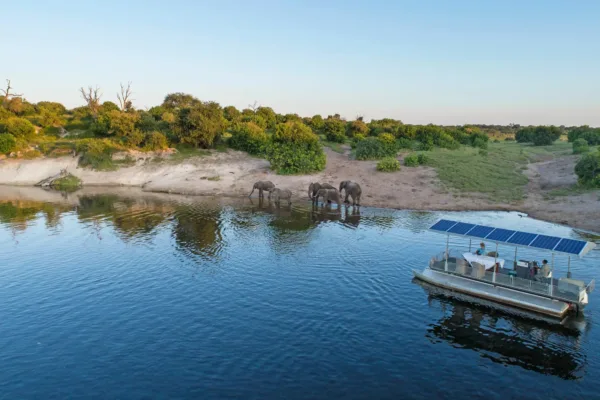
Chobe Game Lodge
Chobe National Park in Botswana is home to one of the world’s most breathtaking wildlife parks, Chobe Game Lodge. High arches and barrel-vault ceilings give the building an air of understated grandeur, while the property’s exquisite architecture draws inspiration from Moorish style.